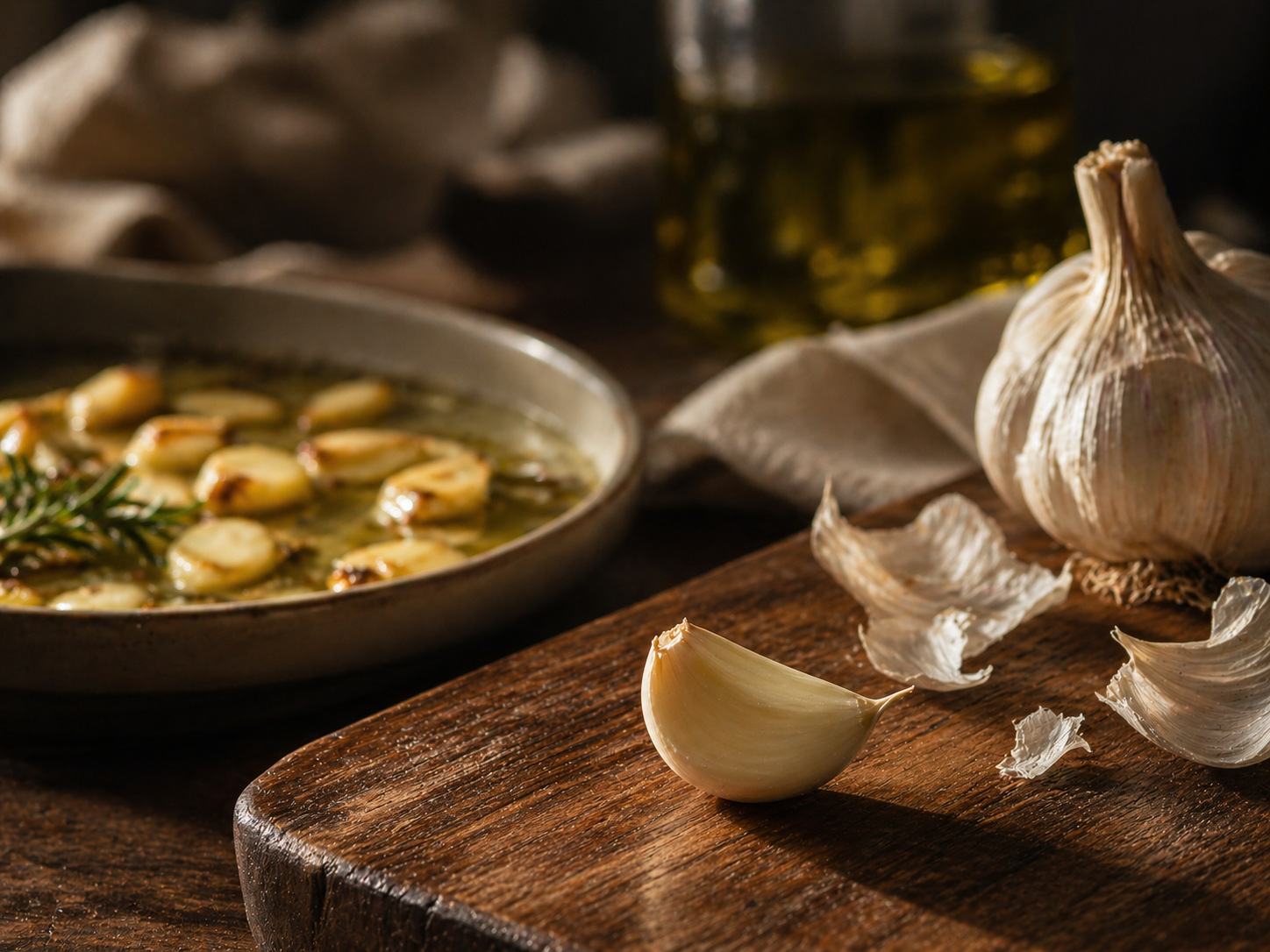
How to cook garlic changes everything about its flavor.

Garlic is the quietest yet most commanding presence in the kitchen.
The sharp fragrance that rises the moment a clove is crushed beneath a knife. The mellow, nutty sweetness that slowly unfolds as it softens in warm oil. The quiet depth that steadies an entire dish from beneath the surface. Garlic is small, humble, and easily overlooked, yet few ingredients shape flavor as completely.
A single white bulb, papery and unassuming, can alter the entire structure of a meal. It does not simply season food. It gives it foundation. It builds the skeleton of flavor.

Garlic is not merely an ingredient that adds fragrance. In cooking, it is often the beginning of aroma—the first note, the base layer, the invisible architecture beneath flavor.
Its character shifts entirely depending on how it is handled.
Raw garlic is sharp, green, and piercing.
Minced garlic is immediate and assertive, releasing its intensity all at once.
Sliced garlic softens into something gentler, more aromatic, with a subtle nuttiness.
Whole cloves, cooked slowly, become mellow and almost sweet.
The transformation is dramatic for such a small ingredient. The same clove can become fiery, delicate, round, or sweet depending on the knife and the heat.
Garlic cooked slowly in oil over low heat loses its sharp edge and becomes soft, almost creamy, with a gentle sweetness reminiscent of toasted hazelnuts. Garlic cooked quickly over high heat behaves differently—brighter, louder, more direct.
It does not simply add aroma to a dish. It decides where the flavor will go.
The same clove, cut differently and treated with different heat, can lead to entirely different meals.
Garlic’s power begins not in aroma, but in chemistry.
Inside each clove is a sulfur compound called alliin, held quietly in place until the garlic is cut or crushed. Once the cell walls break, an enzyme called alliinase is activated, converting alliin into allicin—the compound responsible for garlic’s distinct sharpness and pungency.
That sudden rush of aroma is not just fragrance. It is a chemical reaction unfolding in real time.
What makes garlic especially fascinating is that its flavor continues to develop after it is cut. When minced garlic is left to rest for five to ten minutes before cooking, allicin has more time to form fully. That short pause may seem insignificant, but it deepens the final flavor in noticeable ways.
In this sense, the quiet moment between chopping and cooking is not idle time. It is part of the recipe.
Heat changes garlic just as profoundly.
High heat quickly breaks down allicin, muting garlic’s sharpness and pushing it toward bitterness if left too long.
Low heat softens its edges and draws out sweetness.
Long cooking rounds its sulfurous intensity into something deeper, sweeter, and almost caramel-like.
This is why raw garlic feels sharp while roasted garlic feels soft and sweet. They begin in the same clove, but end as entirely different expressions.
Garlic is rarely the centerpiece of a meal. More often, it waits quietly in a corner of the kitchen—humble, familiar, and always useful.
And yet it is one of the most dependable ingredients to keep within reach.
When the refrigerator is nearly empty, garlic can still make dinner feel complete.
Butter and garlic become the quickest pasta sauce.
Garlic and olive oil turn a single piece of toast into something worth lingering over.
Garlic and soy sauce create an effortless umami base.
Garlic and yogurt add depth to cool sauces.
Garlic and lemon brighten fish, greens, and roasted vegetables with almost no effort.
Garlic is not reserved for elaborate cooking or special occasions. It is what rescues the ordinary table.
It rarely asks for attention. It simply makes everything around it taste more complete.
That is garlic’s quiet brilliance. It does not demand to be noticed. It makes other things worth noticing.
Tonight, try letting a single clove cook slowly in oil.
Watch how it softens. Taste how it changes. Notice how something so small can bring unexpected depth to even a simple piece of bread.
Because what matters is rarely the size of the ingredient.
Only how carefully it is handled.
Leave a Reply